TL;DR: building AD9361 SDRs for clients since 2014, we also built our own open one: the LiteX M2SDR, an M.2 board with an ordinary AD9361 RFIC and a Xilinx Artix-7. The point is not the chip, it is the SoC: with LiteX you reuse the same M.2 PCIe lanes for PCIe, Ethernet or SATA, add SerDes, and discipline it with PTM, PTP or White Rabbit. It is commercial now, customers are happy, and it keeps making LiteX itself better.
“So, what’s the RFIC?”#
That is always the first question about a new SDR, so: another AD936X-based one. 😄
It is a fair thing to raise an eyebrow at. We have been designing FPGA SDRs around this chip for clients for about ten years, and so has half the open-source SDR world. But that is also the point. The AD9361 is proven, well understood, and nowhere near tapped out, and we kept wanting to show what becomes possible when you stop treating the RFIC as the interesting part and put the innovation in the SoC instead. The M2SDR is our own take on that, with no client NDA in the way: fully open gateware and software.
A decade of the same chip, on purpose#
A lot of our contracting has been exactly this since 2014: RF systems on FPGA for a range of SDR companies and integrators, around the AD9361 and plenty of other RFICs. You see the same pattern every time. The RFIC is a known quantity; the hard, valuable, differentiating work is everything around it, the data movement, the host interface, the timing and synchronization, the on-board processing. That is where projects live or die.
The AD9361 is the simple end of what we do, though. Over the years we have built around more advanced RFICs too: the AD9371 (2018) and the ADRV9026/9 family (around 2022), with our JESD204B core handling the high-speed JESD links those parts use. Some of this work has been in production for years, well before the XTRX or the M2SDR: our LiteX and LitePCIe gateware powers Amarisoft’s Callbox, and Amarisoft is a long-standing LiteX user and customer.
We have also worked with the Lime LMS7002M on two fronts: the LimeSDR gateware, which we developed for Lime under contract, and the LiteX XTRX design, which was our own initiative. The XTRX in particular was our first full LiteX SDR SoC, with an initial SoapySDR driver, and it is the work we reused to bootstrap the M2SDR gateware and software.
To be clear about where the M2SDR sits in that range: it is the small, open end, built on the same LiteX foundations as the serious designs but aimed at hackers and experimenters rather than at our partners’ and customers’ markets.
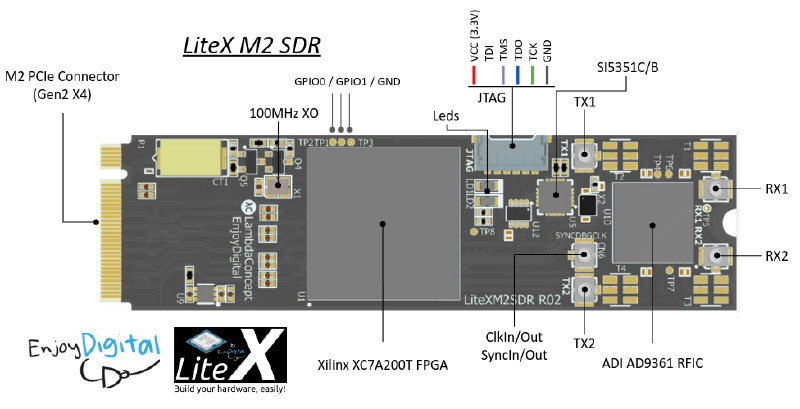
So with the M2SDR the effort went into the SoC, built with LiteX, and the software stack on top. It is a small board (M.2 2280) with a Xilinx XC7A200T and an AD9361, 2T2R 12-bit at up to 61.44 MSPS (122.88 with oversampling), and a PCIe Gen2 x4 link giving roughly 14 Gbps of TX/RX bandwidth through LitePCIe. The FPGA’s base infrastructure uses only a fraction of the part, so there is real room left for RF processing. The hardware is designed by our partner Lambdaconcept; we do the gateware and software.
The different approach: innovate around the chip#
Here is the part that the form factor hides. An M.2 connector carries a handful of high-speed lanes, and because the whole thing is a LiteX SoC, what those lanes are is a build option. The same board can be:
- PCIe up to Gen2 x4 (LitePCIe), with MMAP and DMA for raw or processed IQ.
- 1G / 2.5G Ethernet (LiteEth) over the same lanes.
- SATA (LiteSATA) to record and play samples straight to an SSD.
- SerDes inter-board links (LiteICLink) for coherent multi-board setups.
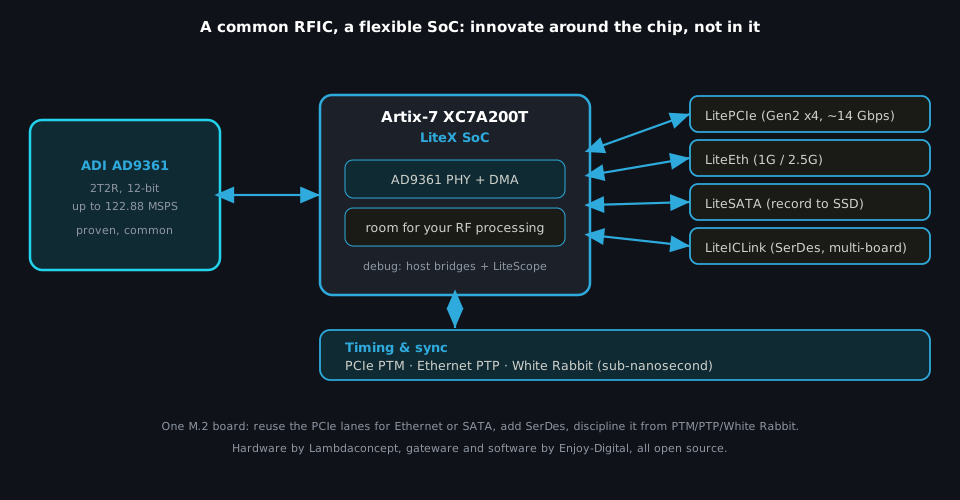
In the M.2 slot you get PCIe directly. The Ethernet and SATA options come when the board is mounted on the LiteX Acorn Baseboard (the Mini variant), which we originally developed around the SQRL Acorn CLE215+ (another M.2 Artix-7 card).
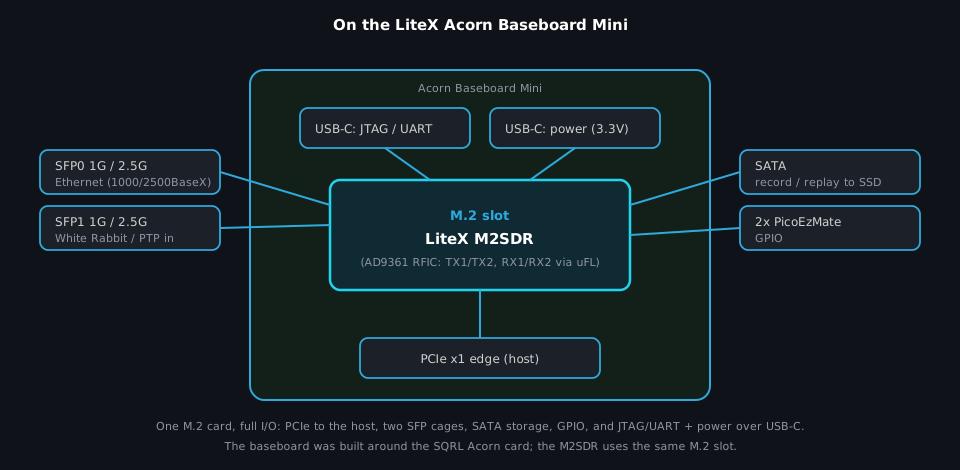
Add to that the LiteX debug story (host bridges and a LiteScope logic analyzer to see inside the running SoC) and multiboot for safe remote updates over PCIe or Ethernet, and the board stops being “an AD9361 SDR” and becomes a flexible platform that happens to have an AD9361 on it. That reframing is the whole idea.
One combination I especially like: put the board on the baseboard, discipline its clock over PTP or White Rabbit, and record or replay IQ straight to an SSD. SATA III (about 550 to 600 MB/s usable) comfortably handles the AD9361 at full rate (61.44 MSPS, 2T2R, samples carried as 16-bit IQ is roughly 490 MB/s), one direction at a time, into a disk that can hold terabytes. Recording time-disciplined IQ straight to a local SSD, with no host in the loop and all from stock parts, is hard to put together any other way.
It makes LiteX better, too#
There is a feedback loop here that I care about as much as the product. A real, commercial, hardware-validated SDR is an unforgiving test of the cores underneath it. Pushing LitePCIe to ~14 Gbps, running LiteEth at 2.5G, recording to an SSD over LiteSATA, getting PCIe PTM and White Rabbit to actually lock: every one of those exercises a LiteX core harder than most projects do, on real hardware, against real software, in CI. The bugs and rough edges this shakes out get fixed upstream, so the whole LiteX ecosystem gets a little more solid and better tested because this one product exists. (It is also why the project ships a real debugging guide, linked from the AI-era post.)
Timing, synchronization, and FEMTO-ST#
The part that has grown the most lately is timing. The board can be disciplined from PCIe PTM (Precision Time Measurement), Ethernet PTP, or White Rabbit, the CERN-born scheme for sub-nanosecond time and frequency transfer.
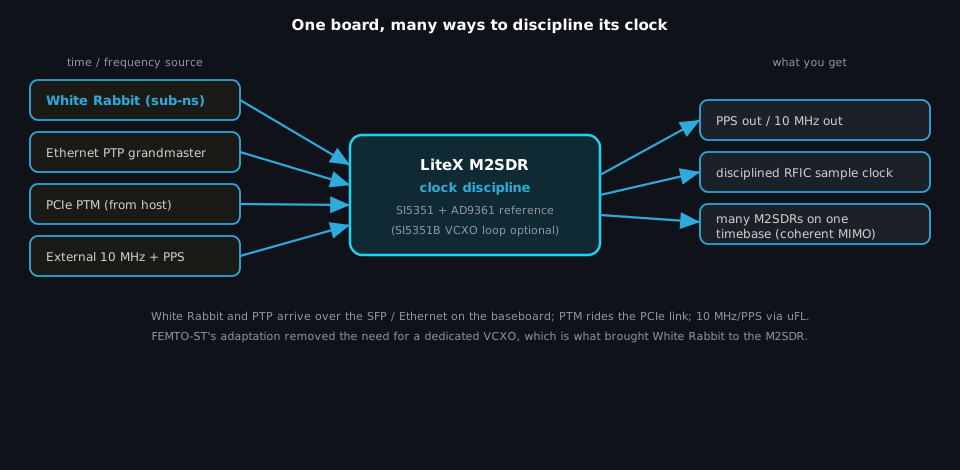
Our White Rabbit work lives in litex_wr_nic. It started as a project for the SPEC A7, a low-cost White Rabbit board developed by the Warsaw University of Technology: we integrated White Rabbit into LiteX and made it reusable across hardware, first on the SPEC A7 and the SQRL Acorn, and now on the M2SDR.
The M2SDR step is thanks to FEMTO-ST. The time-and-frequency group in Besançon, the oscimp / OscillatorIMP people around Jean-Michel Friedt, work exactly at this intersection of White Rabbit, ultra-stable oscillators and SDR. They adapted the design to drop the dedicated VCXO it used to require (their LiteX White Rabbit work is open at oscimp/wr_acorn), and presented the result at the 2026 White Rabbit Workshop.
With that in place we have locked an M2SDR as a White Rabbit slave to a SPEC-A7 White Rabbit master: every board gets a clean PPS and 10 MHz (and from there the RFIC reference clock) off the WR network, so a rack of M2SDRs can share one timebase for coherent work. A cheap, open, WR-disciplinable SDR is a genuinely useful thing to have on a metrology bench. 🙂
Where it is, and where it goes#
The LiteX M2SDR is fully commercialized and on the Enjoy-Digital shop, in two clocking variants, tested with the usual SoapySDR-compatible software and our own C tools and library. Those utilities run over both PCIe and Ethernet today, with the transport chosen at runtime; they are Linux-first, and macOS and Windows support is on the way. Early customers are genuinely happy with it, which is the best signal we could ask for.
And it is only the start. We are actively extending it: SATA record/playback, the 1G/2.5G Ethernet path, and tighter synchronization through the White Rabbit work and the FEMTO-ST collaboration. If you do SDR, time-frequency, or just want a big open FPGA with an RFIC bolted on, come say hello.
Code: github.com/enjoy-digital/litex_m2sdr. Hardware by Lambdaconcept, available from the Enjoy-Digital shop.
Work and ideas by Enjoy-Digital (with Lambdaconcept, and the White Rabbit collaborators above); written up with AI in the loop.