
TL;DR: LitePCIe has always used the PCIe hard blocks of the FPGA vendors. Its DMA, MMAP and MSI cores and its Linux driver run on top of what the hard block provides. FPGAs without such a block could not use it, and people have been asking for a soft PHY since 2019, starting with the Lattice ECP5 and its open toolchain. The soft PHY now exists. It puts the LTSSM, the Physical Layer, the Data Link Layer and the configuration space in the fabric, on top of the FPGA transceivers. It enumerates with the unmodified LitePCIe driver and runs DMA from 2.5 GT/s x1 to 8 GT/s x8 on Kintex-7 and Kintex UltraScale+ boards. A few days after it landed, Dirk Eibach brought it to the ECP5 Versa. At Gen3 x8 it also makes a point we already knew: on large configurations it fills a good part of an XCKU3P, where the hard block costs almost nothing.
A request since 2019#
The request is issue #20, opened in May 2019 by Tim Ansell: support LitePCIe on the Lattice ECP5 SerDes, with the open toolchain. The ECP5 has no PCIe hard block, only transceivers. whitequark had already shown the ECP5 SerDes locking on a PCIe stream with Yumewatari, and others started their own attempts. Over the years, more requests followed for other targets: a Xilinx soft PHY (#83), GateMate (#151), an ECP5 contribution whose first look estimated a “multi-quarter scope” (#164), and a soft Data Link Layer for devices without a hard block (#165).
We closed #20 once, in 2021, as “not realistic for now”. The reason was economic, not technical. A PCIe endpoint without a hard block needs:
- the Physical Layer: 8b/10b, scrambling, Ordered Sets, lane deskew, clock compensation, and 128b/130b at 8 GT/s;
- the LTSSM, the link training state machine: Detect, Polling, Configuration, L0, Recovery, speed changes and, at 8 GT/s, transmitter equalization;
- the Data Link Layer: sequence numbers, LCRC, ACK/NAK, a retry buffer that replays lost packets, and flow control credits;
- the configuration space that the host reads at enumeration.
Each of them follows a large specification closely, and a host is not forgiving: a wrong field or a missed timeout ends in a link that never trains, or in a machine that hangs at boot. That is months of work, and it only pays off if someone needs it badly enough to fund it. In January 2025 the issue had a bounty pool of 11,400 EUR, with 2,000 EUR from Enjoy-Digital, against whitequark’s estimate of 8,000 EUR, which we already considered on the low side for the work. It was not enough to make the work happen.
Others kept working on the ECP5 side in the meantime. In April 2026, zyp published katsuo-pcie, a proof of concept of LitePCIe on an ECP5, built on a separate PCIe stack with ECP5 support that zyp had been working on for a while.
It is the same story as USB3-PIPE: a protocol stack that follows a specification closely is a long task that never fit in the funding available. With AI in the loop, it became tractable.
The soft PHY#
SoftPCIEPHY is a drop-in replacement for the hard block PHYs in LitePCIe. The endpoint, the DMA,
the MMAP bridges, MSI and the Linux driver see the same interface, so a design moves from a hard block
to the soft PHY by changing its PHY. Below that interface, everything is in the fabric:
- Transaction Layer glue: TLP framing, a Type 0 configuration space with the PCI Express, MSI and power management capabilities, completions for configuration requests, Unsupported Requests;
- Data Link Layer: DLLPs, LCRC, the retry buffer and flow control, at x1 and in a wide version that handles one DW per lane per cycle at x2 to x8;
- LTSSM: the training state machine, upstream and downstream roles, speed changes up to 8 GT/s and equalization;
- Physical Layer: per-lane datapaths, Training Sequences, SKP insertion and removal, striping and deskew;
- transceivers: through LiteICLink, with adapters for the Artix-7 GTP, Kintex-7 GTX and UltraScale+ GTY.
The LTSSM uses the Xilinx UltraScale state encoding, so the LTSSM tracer and tools that LitePCIe already had keep working. The approach is the one of USB3-PIPE: the transceivers do the serialization, and the protocol runs in the fabric.
A week, simulation first#
The first commit landed on 6 November, and Gen3 x8 ran on hardware on 10 November. The order matters more than the speed:
- Building blocks with reference models: the scrambler, the LCRC and DLLP CRC, Training
Sequences, each checked against Python models (the LCRC against
zlib.crc32). - A link in simulation: two Physical Layers in Verilator, through transceiver models with ppm offsets, polarity inversion and symbol shifts, training to L0 and exchanging packets. Then the Data Link Layers on top, with corrupted words and lost DLLPs: every TLP delivered once, in order.
- An endpoint against a host model that follows the Linux driver’s register sequence: CSRs over BAR0, DMA tables, loopback through host memory, MSIs.
- Hardware, with the LTSSM disabled at reset and by PERST#, so that a design that hangs the host cannot do it again at the next boot.
On a YPCB-00338-1P1 (Kintex-7 XC7K480T, GTX), the first hardware run enumerated, loaded the LitePCIe driver and passed the register, MSI and DMA tests on the same day. Gen2 and x2 to x8 followed the next day, 8 GT/s the day after in simulation, and then the Kintex UltraScale+ GTY on the Alibaba Cloud XCKU3P card.
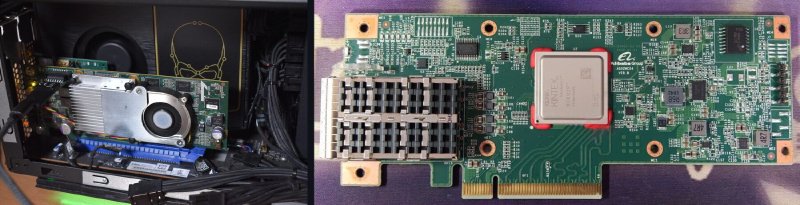
The hardware found what the simulation could not. A TLP packetizer bug lost the last beat of a 4 DW Memory Write followed by a 3 DW Completion: it was not in the soft PHY but in LitePCIe itself, and it is fixed for every PHY. MSIs starved under sustained DMA until they got priority. On the GTX at 8 GT/s, the receiver reported Electrical Idle on a live signal and squelched the data. The eye from the host was closed while the near-end loopback was clean, which points to the channel of that board at 8 GT/s. The same code trained at 8 GT/s on the GTY.
Results#
On the Kintex-7 GTX (YPCB-00338-1P1), against the hard block of the same board, with the LitePCIe
driver’s dma_test loopback over 15 minutes:
| Kintex-7 GTX | Soft 5 GT/s x1 | Soft 5 GT/s x4 | Soft 5 GT/s x8 | Hard IP 5 GT/s x8 |
|---|---|---|---|---|
dma_test | 3.39 Gb/s | 11.57 Gb/s | 14.97 Gb/s | 13.3 Gb/s |
| Correctable errors at the root port | 0 | 0 | 0 | 0 |
| Link cycles (remove, retrain, rescan, test) | 20/20 | 20/20 | 20/20 | |
| Slice LUTs, whole design | 8,617¹ | 20,095 | 41,553 | 8,407 |
¹ 2.5 GT/s x1 build.
Above about 13 Gb/s, dma_test itself does not keep up: its software check loses whole buffers on
both PHYs. The link also negotiates down from x8 to x4, x2 and x1 when lanes are kept out.
On the Kintex UltraScale+ GTY (XCKU3P), the soft PHY trains at 2.5 GT/s, and the root port moves it to 8 GT/s with the equalization phases 0 to 3. At 8 GT/s x8, a test program on the driver’s library received 23.8 Gb/s of DMA data and checked it: 1.78M buffers in 5 seconds, none wrong. Retrain Link from 2.5 or 5 GT/s back to 8 GT/s worked 60 times out of 60.
The goal of this first version was a link that trains, enumerates and moves data reliably at every speed and width, not throughput: 23.8 Gb/s is well below the 63 Gb/s the link can carry.
Update, November 17: a first round of throughput work is merged (no idle cycle between received TLPs, the next packet prepared in the replay buffer, a receive path sized for bursts of completions). On the same card and host, with 32 read requests in flight in the DMA of the soft PHY design, and the LiteX-Boards target at a 200 MHz system clock for the hard block:
| XCKU3P, 8 GT/s x8, DMA data checked | Soft PHY | Hard IP |
|---|---|---|
| Loopback (host to FPGA and back) | 31 Gb/s | 33.8 Gb/s |
| Host to FPGA only | 34.2 Gb/s | |
| FPGA to host only | 41.7 Gb/s |
A 15-minute loopback soak moved 430M buffers with none wrong. In loopback, the soft PHY is now within 10% of the hard block, and the host limits the host to FPGA direction. None of these numbers is a maximum yet, and at 5 GT/s x8 we have not identified what limits the soft PHY to about 18 Gb/s.
Gen3 x8 and the XCKU3P#
Width and speed have a cost in the fabric. At 8 GT/s x8, the link carries 64 Gb/s, which the soft PHY handles at 125 MHz on 512-bit beats. Every lane needs its own 128b/130b blocks, descrambler and equalization. The Data Link Layer has to find packet boundaries anywhere in the beat, compute an LCRC over the whole beat, and repack TLPs that start in the middle of it.
The first Gen3 x8 synthesis needed 202K LUTs, 124% of the XCKU3P. A round of area work brought it into the device: the TLP repacker writes into banks and rotates on reads, the LCRC is computed over the whole beat and rewound, the 8 GT/s framer works on pairs of slots, and the 8b/10b framer runs at half the width on 8 GT/s capable links.
| XCKU3P (162,720 LUTs), Vivado 2024.1, timing met | CLB LUTs | CLBs used | Registers | Block RAM |
|---|---|---|---|---|
| Soft PHY Gen3 x8, first build | 202K (synthesis) | did not fit | ||
| Soft PHY Gen3 x8, after the first area changes | 111,153 (68%) | 78% | ||
| Soft PHY Gen3 x8, current | 82,434 (51%) | 57% | 69,610 (21%) | 57 (16%) |
| Soft PHY Gen3 x8, with 32 read requests in flight (the November 17 rates) | 107,874 (66%) | 74% | 84,382 (26%) | 65 (18%) |
Hard IP Gen3 x8 (PCIE40E4), LitePCIe endpoint from the LiteX-Boards target | 13,213 (8%) | 11% | 17,287 (5%) | 45.5 (13%) |
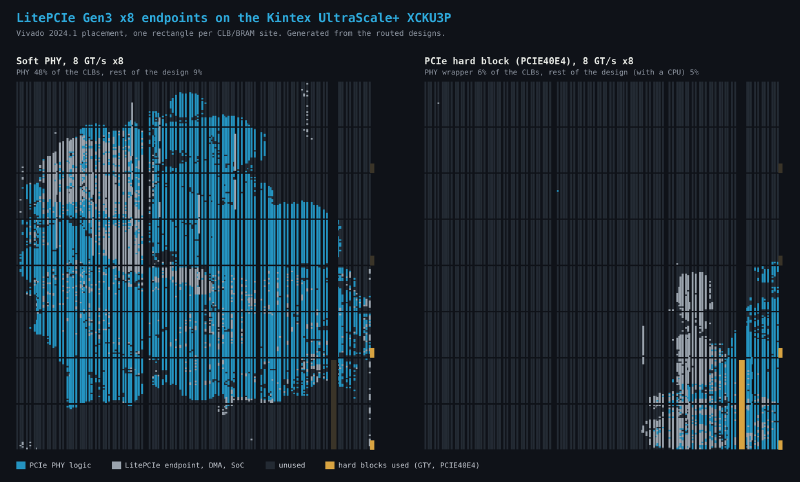
The device view at the top of this post shows what that means. It is drawn from the placed designs:
one rectangle per CLB, blue where the PCIe PHY logic is placed. On the soft PHY, the PHY alone takes
48% of the CLBs, and the endpoint, DMA and SoC another 9%. On the hard block, the PHY wrapper takes 6%,
and the rest of the design 5%, even with the VexRiscv CPU of the LiteX-Boards target, all next to the
PCIE40E4 and the transceivers.
Our implementation is not optimal yet. The area work so far took a design that did not fit down to half of the LUTs in two passes, and we will probably optimize it further. But even optimized, a soft PHY for large configurations will stay much more expensive in resources than the hard block. The hard block does the same work in silicon, at no cost in LUTs, with its timing already closed. For large configurations on devices that have one, the hard block stays the right choice.
The soft PHY is for everything else: FPGAs with transceivers but no PCIe block (ECP5, GateMate, smaller Gowin parts), devices that need more PCIe ports than they have hard blocks, Gen1 and Gen2 links at x1 to x4, where the cost is moderate (about 8.5K LUTs at x1 on an Artix-7, against 4.5K on the hard block), and work where seeing every layer of the link matters more than its area.
The ECP5, the original request#
The soft PHY is recent, and it has already been tested on the ECP5, the target of the 2019 request. In April, Dirk Eibach wrote on #20 that it was time to dust off his Versa PCIe test rig. In November, a few days after the soft PHY landed, he did, and in his words, “things escalated quickly”. The port could also build on the earlier ECP5 PCIe work: Yumewatari had worked out how to put the DCU in PCIe mode and detect a receiver, and katsuo-pcie had shown LitePCIe running on the Versa.
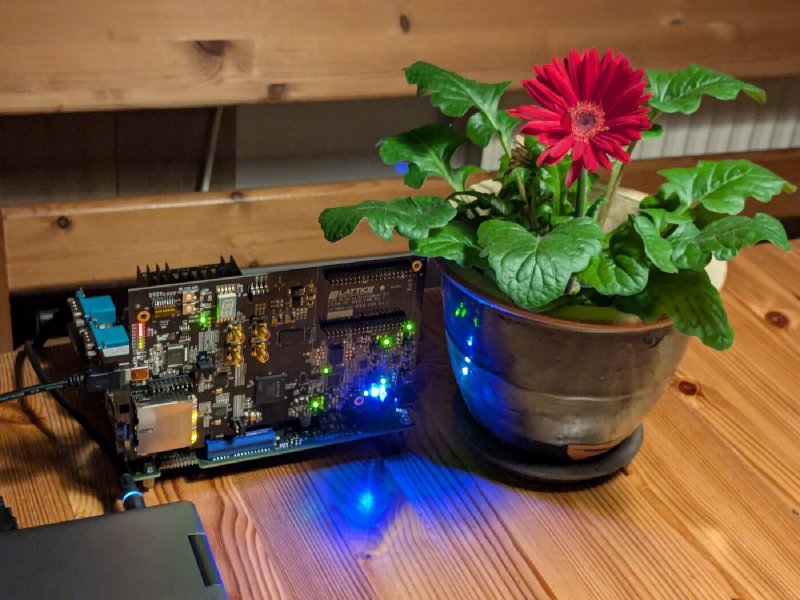
The port uses our soft PHY as it is: everything above the transceiver, from the Physical Layer to the configuration space, is the same code as on the Xilinx boards. He added an ECP5 lane adapter below it: the DCU in PCIe mode through LiteICLink, the receiver detection sequence, clocking, a behavioral DCU model for simulation and a Versa bench. For the DCU side, the PCIe-mode attributes and the receiver detection sequence follow Yumewatari and Lattice’s documentation, and katsuo-pcie confirmed them. No code was taken from either. Like ours, much of the work was done with an AI agent (Claude Code), under his supervision. On the Versa (LFE5UM-45F, the non-5G part), in a Fujitsu FUTRO S920 with the unmodified LitePCIe driver:
| Lattice ECP5 Versa, Gen1 x1, open toolchain | |
|---|---|
| Enumeration | at boot |
| MSI | OK |
dma_test loopback | 1.66 Gb/s, 0 errors |
| 15 minute DMA soak | 22.8M buffers, 0 errors, no replay, no receiver error |
| BAR0 stress, 15 minutes | 106.5M writes with readback, 0 mismatches |
| Link cycles (unload, remove, retrain, rescan, load, test) | 20 of 20 |
| Resources, whole SoC with DMA and analyzer | 24,400 LUT4 (55%), 10,793 FFs, 56 of 108 DP16KD |
It is split into small pull requests: LiteICLink #111 for the PCIe option of the ECP5 SerDes, then LitePCIe #250 for the adapter, model and bench, with two simulation PRs (#248, #249). They are under review. Everything around them (bring-up runbook, host tools, hardware log and a pinned build recipe that regenerates the tested design) is in eibach/ecp5-pcie-core, so the results can be reproduced.
That is what we hoped for when we started: a core that others can take to their own hardware, in days rather than quarters.
What is not done yet#
- The Artix-7 GTP, the first target on paper, has not run on hardware yet.
- No lane reversal, no L0s/L1 power management or ASPM, no MSI-X.
- 8 GT/s at the full width only: width negotiation is done at 2.5 and 5 GT/s.
- On the GTX, 8 GT/s with a host is still open on the board we used.
- Throughput: not optimized yet, see the results above.
- More area work at large widths, and other transceivers: GateMate and Gowin are on the list.
Try it#
git clone https://github.com/enjoy-digital/litepcie && cd litepcie

# Simulation: two Physical Layers at 8 GT/s x8, equalization and a Link Retrain.
python3 bench/soft/sim_wide.py --phy --gen3 --nlanes 8 --eq-preset 8
# A LitePCIe SoC with DMA against a host model.
python3 bench/soft/sim_soc.py --gen3 --nlanes 8

# Hardware: the full endpoint on the Alibaba Cloud XCKU3P card at 8 GT/s x8.
python3 bench/soft/ku3p.py --with-endpoint --speed gen3 --nlanes 8 --driver --build
The design, status and hardware results are in doc/softphy.md, and the soft PHY chapter of the
LitePCIe manual.
Thanks to Tim Ansell for the original request, to everyone who pledged on #20, to whitequark (Yumewatari) and zyp (katsuo-pcie) for their ECP5 PCIe work, and to Dirk Eibach for the ECP5 port and the Versa photo.
Work and ideas by Enjoy-Digital; written up with AI in the loop.